

You lugged it from the builder’s yard.
Now it’s my turn to know its stiff weight,
the slow chafe of pine against vertebrae:
a decade-long kiss, flush with splinters.
I closed it when I left. The lock snicked.
Then I noticed it hitching a ride. It never
gives up―patchy blue, invisible straps;
a faint knocking though nobody’s there.
So many slab hazards: repeated thumps
to my skull, brass hinges clouting strangers
as we creep into lifts, beds. I lie awake
on its panels, framing rectangular thoughts,
obsessed by the side I can't see; what grows
there. The problem is you died so there’s no way
to set the thing down, no wall to prop it against
with its stuck handle and fracturing paint.
All day we continue our back to front tango,
this dance where I almost but never arrive,
where I’m shut off to visitors for hours
then, with one touch, swing wildly open.
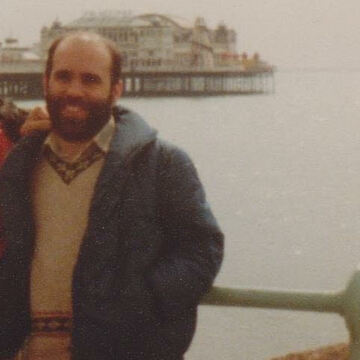
Ian Scobbie was a remarkable man - originally from Scotland, he became a mature student at the University of Bradford, on a translation and interpreting course which is where I met him back in the late 1970s. Subsequently we worked together in a translation and information department in the public sector. Ian was a brilliant linguist, fluent in Russian and German, but far more than this: a pianist, poet (compiling, in particular, hilarious and scurrilous verse about colleagues), DIY enthusiast, cook and foodie, lover of musicals in which he performed, devotee of Dusty Springfield, Kiki Dee and others; Master of Ceremonies at Burns Night parties; a wit and raconteur, and most of all, a warm-hearted and supportive friend.
In 1986, knowing he had AIDS but not wishing to share this knowledge with others, Ian emigrated to Germany and died there not long after starting a new job and moving into a flat there.
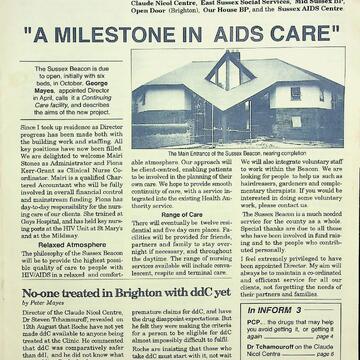
Free news sheet which details Brighton local HIV healthcare stories and support. Includes sections covering aromatherapy, HIV service forums, medical matters, figures regarding HIV, positive news stories.
"Interview with John Rosewarn for Queer in Brighton Oral History Project (28 May 2013), interviewed by ??.
Oral history interview collected as part of the Queer in Brighton project 2013-2014. Life history from Taunton to Brighton DOB 1944 circa - leaves home at 18 (gets thrown out by father after being caught in bed with dad’s best mate) goes to London -sex worker from 18 to 24 years of age 1961 to 1967 - moves to Brighton 1969. Trains as a nurse - lives in Brighton- work students in Hayward’s Heath. Moves to Spain from 1991-1999. Talks about sex work, cottaging and it’s demise in the early 1980s, celebrities, work as a nurse, homophobia, bars in Brighton, his relationship with older man - open relationship- promiscuity, first Pride, estrangement from parents, drag persona. "
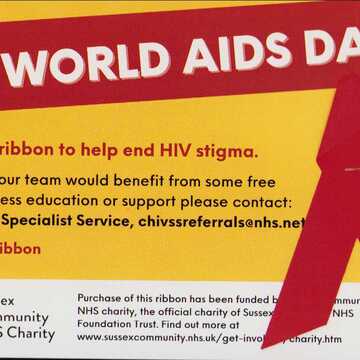
Card from Community HIV Specialist Service for World Aids Day with a wearable ribbon attached to support world AIDS day. It is part of the campaign by Sussex Community NHS Charity for #RockTheRibbon, to help end HIV stigma.
Janet tells Roni and David which are the objects that would best tell her personal queer story.
Recorded on October 20, 2020
Janet Jones grew up in West Yorkshire and lives in Brighton. She is a writer, queer and disability-rights activist, film makers, and all round source of many stories and anecdotes.
In this interview Janet talks about her youth, self-discovery, writing and performing during the AIDS crisis, activism, death, life, and joy!
Recorded on October 20, 2020, on Janet's balcony in Brighton, as part of the My Queer Museum podcast series
Interview by: Roni Guetta and David Sheppeard
Editing and original music by Olive Mondegreen
Kevin John Dodd
When I think of Kevin John Dodd, the memory that ignites is the one of him emerging from the Pepper-pot toilets by Queens Park one summer dressed in a T shirt and shorts. When he saw me walking into the park, his face broke into a broad grin and we both burst out laughing, because he knew that I knew what he’d been getting up to. I met Kevin at the Sussex AIDS Centre and Helpline when I was a volunteer there, and we got along straight away due to a shared sense of humour and a love of self-deprecation. Kevin was a member of Our House BP, and also sat on the board of the Sussex AIDS Centre as their representative.
When Kevin died in February 1992, his service was conducted by Father Marcus Riggs, and took place at the Woodvale Crematorium off Lewes Road like many in those days. I remember the order of service had a black and white outline of Mickey Mouse on the cover page which made me smile. The music Kevin chose for his funeral was an eclectic mix. I remember ‘Nimrod’ from Elgar’s Enigma Variations in particular filling the space with undulating dissonant chords and an emotional resonance that had me sobbing into my sleeve. Later in the service ‘Reach out and touch’ by Diana Ross also hit the same spot albeit in a very different way. I think it was Kevin’s funeral that made me think for the first time about the songs that I might use to serenade my own passing, because back then life seemed so fleeting and death was everywhere. I will always remember Kevin for being cheeky, confidant, funny and completely fearless and all these years later, he is still missed by many. Harry Hillery 2021
Latex Theatre was initiated as part of a sexual health project, in Leeds, in the early 90s. The group met weekly in the AIDS Advice Centre, and wrote collectively and individually.
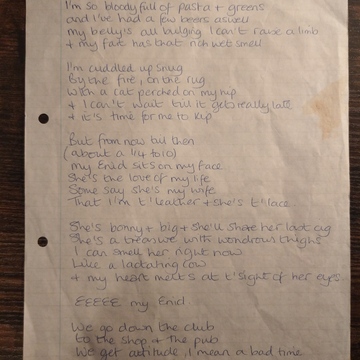
1. A manuscript of a poem that Janet co-wrote in 1994 with her partner. The poem was read and performed on tour across the country.
2. A photograph of Janet and another member of Latex theatre performing a short piece at London Pride between 1993 and 1995.
The piece was short and punchy and delivered in an angry tone. Each of the sentences was made from tabloid newspaper headlines, and the homophobic language used around HIV/AIDS.
"AIDS, you're better off dead.
AIDS, a bullet in the head.
AIDS, you made your bed, lay on it"
3. Stupid Bastard: a sketch written by Janet Jones for Latex Theatre in 1993. The piece is a commentary on current legislation on AIDS, rape, MSM, the prison population, the age of consent, and drug use.
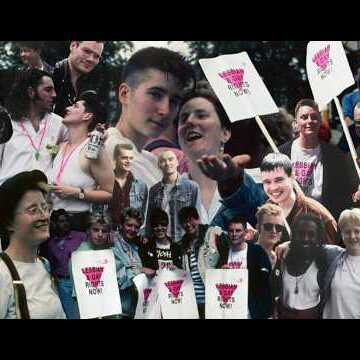
Abigail Dombey in conversation with Kate Wildblood, reflecting on queer life on Brighton during 1989-1992 and the community created through protest and Pride courtesy of the discovery of Abigail’s long lost slide film collection.
From her job in the local camera shop to the streets of Brighton, Abigail Dombey, a budding 18-year-old queer reportage photographer, was capturing the passion and the prejudice of early 1990s Brighton, one 35mm slide film at a time.
A time where bigotry and fear stalked the LGBTQ+ community as they fought against the Tories’ hateful Section 28 legislation, the media’s toxic narrative and society’s demonisation of queer lives at a time of the HIV and AIDS pandemic. A time of Doc Marten’s pounding the streets in protest, placards held high, hearts full of the desire for action (and occasionally each other). A time of grassroots activism as the shame fuelled by Section 28 loomed large over our lives, homophobic violence a daily reality, challenging our sense of LGBTQ+ community as we fought to create our modern day Pride movement.
It was our time, of baby dykes and glorious queers, of prejudice, protests and those all-important picnics. A time that saw us determined to challenge the unremitting homophobia that filled our lives and change the world together. One protest t-shirt at a time.
History isn't just in the past; it's in the present. All the steps and moments we take as a community lead to radical changes. We invite you to bring photos or look through your memories of what's in Brighton and is making history. We will have a map of Brighton to gather around and discuss what makes Brighton the place for you.
Queer Heritage South; powered by Marlborough Productions. Made possible thanks to The National Lottery Heritage Fund.
Filmed by Lucy Lebrocq
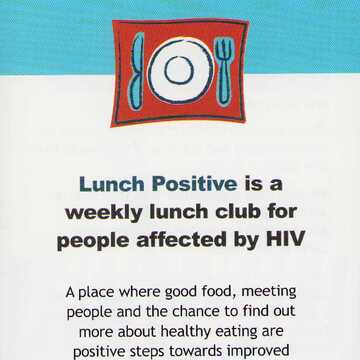
Flyer advertising Lunch Positive, a weekly social group for people living with HIV in Brighton. Meetings were held every Friday in Dorset Gardens Methodist Church and involved sharing lunch and meeting and supporting other people with HIV.
Lunch Positive was established in 2009 as a weekly lunch club for people living with HIV and their carers. It provides a welcoming space where good food, meeting people and the chance to find out more about healthy eating are positive steps towards improved well-being.
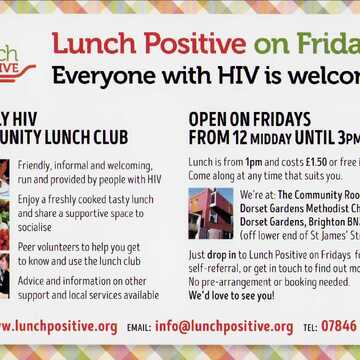
The club meets every Friday from 12 noon to 2.30 pm, with lunch served from 1 pm at the Community Hall, Dorset Gardens Methodist Church.
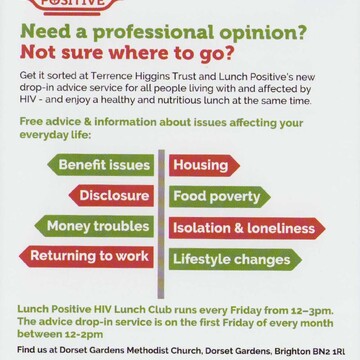
Get it sorted at Terrence Higgins Trust and Lunch Positive's new drop-in advice service for all people living with and affected by HIV, and enjoy a healthy and nutritious lunch at the same time.
Free advice and information about issues affecting daily life, including benefit issues, housing, disclosure, food poverty, money troubles, isolation & loneliness, returning to work, lifestyle changes.
Lunch Positive HIV Lunch Club runs every Friday from 12–3 pm. The advice drop-in service is on the first Friday of every month between 12–2 pm.
Weekly HIV community lunch club opens on Fridays from 12 midday until 3 pm. Lunch is from 1 pm and costs £1.50, or is free if needed. Come along at any time that suits you.
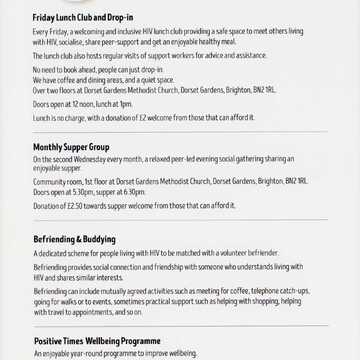
Lunch Positive provides HIV community support, including: Friday Lunch Club and Drop-in, Monthly Supper Group, Befriending & Buddying, Positive Times Wellbeing Programme, Eastbourne & Hastings Social Groups, Women's Group, Walk & Talk Therapy, Volunteering, Pantry & Food Bank, Home Outreach.