Search results
-
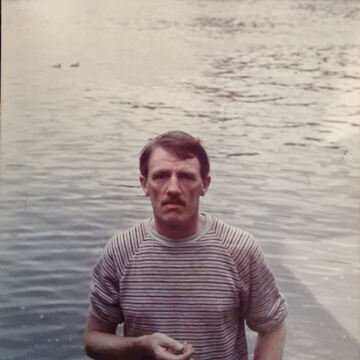
Eddie and I met at Earls Court’s Club Copacabana on Tuesday 6 September 1983, when I accidentally tripped him up and spilt his drink. Mortified I bought him another one and we got chatting. I was a spikey haired post-punk/goth 18-year-old, and Eddie a stereotypical 1980’s clone. He invited me back to his flat in Chiswick and I stayed for 5 days, missing college. I told my parents I was staying with friends. Within a few months I left college and moved in. It was a gradual process, but Eddie knew I was serious when my record collection arrived. Eddie was born and brought up in Glasgow on the infamous Easterhouse estate. He was a proud working-class man and HGV driver who drove Adam & Ants and Jordan around Italy on their 1978 tour. Eddie tried in vain to turn me into a clone, by taking me to all the bars and leather clubs in London. It was around this time that we read about a disease largely affecting gay men in the States called GRID (Gay Related Immune Deficiency), later known as AIDS. It became all the talk in the gay press and bars. We volunteered to take part in early research conducted at Hammersmith Hospital and regularly had our bloods tested. We were together for 2 years, and remained close friends after we broke up. A few months later Eddie tested positive, and he joined the organisation Body Positive through which he found purpose, support and friendship. Pretty soon, he was the centre’s caretaker, one of the unseen heroes doing the unglamourous but much needed jobs. When Eddie became unwell, he decided not to go to the London Lighthouse, which was nearer to his home. Instead, he chose the Mildmay Mission in East London, because as a proud working-class man he felt more comfortable there. After Eddie died, I wanted to make a quilt panel for him, so I joined a quilt making workshop in Brighton run by Arthur Law. The panel I made for Eddie shows all the simple pleasures which made him happy. A mug of coffee, some hobnobs, a cigarette and the Evening Standard crossword. After completing the quilt panel, his death still felt too raw for me to show the piece in the 1993 Brighton Remembers, so I kept it at home, until now.
-
I first met Gary sometime in the mid 80’s. I’m not sure where but I think it was to do with Body Positive business. He and his partner Sebastian were also engaged with The London Lighthouse in some capacity. Sebastian was very handsome and a few years younger than Gary. One afternoon I met them outside the Ladbrook Grove tube station with Rusty their new little Jack Russell cross who was gorgeous. They asked me to hold him whilst they went to use a loo and when they came out, we had a coffee somewhere nearby. They told me that Sebastian was moving to Brighton, with Gary following as soon as he could. I met them both again in Woolworths on Oxford St the day before Sebastian was moving, but I never saw Sebastian again because he died before I moved to Brighton. Gary was not a run of the mill chauffeur. He worked as one of the top drivers for the most important chauffeur service in London Victoria. He drove everyone - heads of state, celebrated film stars, rock musicians and many other world-famous people who specifically asked for him time and time again. I think he must have had some kind of intelligence background due to the importance of the people he drove, but I can’t say for certain. He was also a great dancer and lovely human being. Gary and Sebastian bought a house in Kemp Street a few doors up from the artist Gary Sollars. They were both members of the newly formed LGBT Line Dance group which I also joined later. We became a very close-knit group of friends and danced our hearts out for a couple of years. Sadly, Gary went from HIV status to full blown AIDS so I started visiting almost every day to take Rusty out for a walk. When I came into the living room Rusty would jump all over me and I’d kiss and cuddle him for a few minutes before going over to kiss and hug Gary. We walked all over Brighton, and when Gary went into The Sussex Beacon, Rusty came to live with me. We were told that Gary only had a few weeks to live and wanted to return home to die. We all helped, taking turns to look after Gary and do all the cooking, shopping and cleaning. The whole house became alive with fabulous energy. We laughed, cried, ate together, slept overnight and read to Gary until the final week when he slipped in and out of consciousness. Gary told us he didn’t want his sister to have anything to do with his death or its aftermath, and he left a letter at the Sussex Beacon saying they were not to inform her. Unfortunately, the letter was not read until it was too late. She arrived the day before he died and was furious that we were all having such a wonderful time making Gary’s last days positive and bearable. Gary had one of the best deaths I have ever witnessed until she poked her nose in. We would not let her interfere, but she wouldn’t leave Gary’s house until after the funeral. There was one problem, Rusty. I said I could not take him so said she’d build another kennel outside for him next to her other dogs. This horrified me and all the others, so I quickly changed my mind and took Rusty home with me that evening. He lived for another 4 happy years, and I still have an oil painting of him above my desk.
-
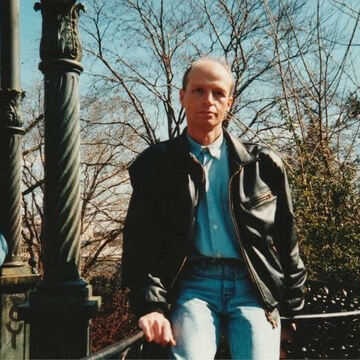
Graham Charles Wilkinson Graham Charles Wilkinson was one of small group of gay men in London who shared a vision for innovative new centres for people living with HIV in the UK. The group started to meet and talk about their ideas at the flat of Christopher Spence OBE, who’d later become director of the Lighthouse in Ladbroke Grove when it opened in 1986. Graham was acutely aware that Brighton was desperate for services to help the growing numbers affected by the epidemic, so he set to work bringing the vision to the coast. Determined and courageous, Graham decided to quit his job to found the Sussex AIDS Helpline in a ‘grotty’ little office on Brighton’s Western Road in October 1987. In the early days, the helpline was a very hands-on affair with Graham and a few friends answering all the calls, but despite its humble beginnings, it soon became essential for anyone needing good advice, compassion and the facts. By all accounts Graham was a shy man who found the constant battles, resistance and stigma of the times hard to manage against the backdrop of his own illness. Sometimes the stress of the situation would get the better of him, but before long the light would appear in his face alongside an infectious giggle that anyone who knew him will never forget. By all accounts, Graham was a loving and supportive man who could be relied on to give someone a cuddle. Graham lived on Devonshire Place in Kemptown with his partner and playwright John Roman Baker at the time. They used their flat as a centre for the fundraising and lobbying which helped Graham to realise his vision when the Sussex AIDS Centre and Helpline opened at 3 Cavendish Street in 1988. Despite his poor health Graham played a key role in shaping, influencing and establishing the HIV services in Brighton which continue today, and his tireless commitment served to directly impact and improve the quality of lives of countless people living with HIV in Brighton. Graham ended his days at the London Lighthouse on 22 August 1990 surrounded by friends. His service was held in St Peters Church with standing room only - a testimony to the love and respect that existed for him in the city. - Danny West - 2021 22 August 2021 This evening, John and I are listening to Donna Summer and remembering Graham Wilkinson who died this day 31 years ago at London Lighthouse (at the time there was no hospice for people with HIV/Aids in Brighton). He was a tireless gay rights campaigner from the 1970s onwards and then in the 1980s fought tooth and nail as co-founder and director of the Sussex Aids Centre & Helpline (now THT South). His work, spirit and achievements should not be forgotten. It was a time when gay men in particular, but also others with HIV, were collateral damage in a deeply Conservative society where sadly even within our own community we had to fight self-hatred while the government held out for a feared heterosexual epidemic which of course (thankfully) did not materialise. Graham inspired and touched the lives of so many, but to John and myself he was so much more. He was our family and is deeply missed. Words by Rod Evan & John Roman Baker