


Looking inward, looking outward, looking forward: Emily’s dissertation research on the importance of queer digital archives
17th June 2026
My name is Emily Hathaway, and I am currently doing an internship with Queer Heritage South at Marlborough Productions. I recently finished the third and final year of my BA Anthropology course at the University of Sussex, and I conducted my dissertation research on queer digital archives. As a queer woman, I was interested in the ways that archives can represent queerness but also how they can affect the lives of those who interact with them. In exploring the digital archive, I became more and more fascinated with the power that they hold. I decided to conduct my dissertation research on this very topic.
In the beginning of 2026 I interviewed six queer members of the public during a session where we explored and engaged with the Museum of Transology and Queer Heritage South archives. My aim was to explore how queer digital heritage archives are experienced by the people they aim to represent, andts and feelings of queer people as they interact with the archives.
Looking Inward

Colin Lievan’s Embroidered Denim Jacket & Skirt, 2019. Image owned by Queer the Pier, Brighton Museum & Art Gallery, Photography by Zoltan Photography.
In engaging with these queer photos, leaflets, flyers and more, participants found that they were able to reflect on their own queer identities. Seeing queer lives in this accessible, visible, and unashamed way allowed them to consider the memories and stories they would use to describe their own queer heritage. One participant, after I had asked what sort of objects they might consider donating to the archive, stated:
“the rainbow tote bag?..like I remember when I first came out that was such a thing, like I’d be able to spot all the gays cos everyone had that rainbow tote bag.”
Through the visibility of queer objects and stories, this participant practiced self reflection and was able to link the experiences of queer people from the archive to their own queer experience. This highlights the importance of Queer Heritage South and queer archives in general- they can help queer people understand their own identity better. They allow us to look inward. Another participant commented on seeing memories and stories exhibited in the archive:
“I think it’s a lot more personal because it’s, it’s like about specific people and even though you don’t know who they are, they apply to so many people.”

Gay Soc Meeting- University of Sussex, c. 1979.
Something that sets apart the Queer Heritage South archive from other archival spaces is the contributor’s ability to add their own description when contributing objects to the archive. In a time when queer- especially trans, non-binary and intersex- voices are continuously silenced by the media, this is more important than ever. Queer people can reclaim the narrative that has been pushed upon them by describing in their own words the story or meaning behind their specific object. In doing this, Queer bodies become not just an object of spectacle, but the curators of their own truth.
Looking Outward

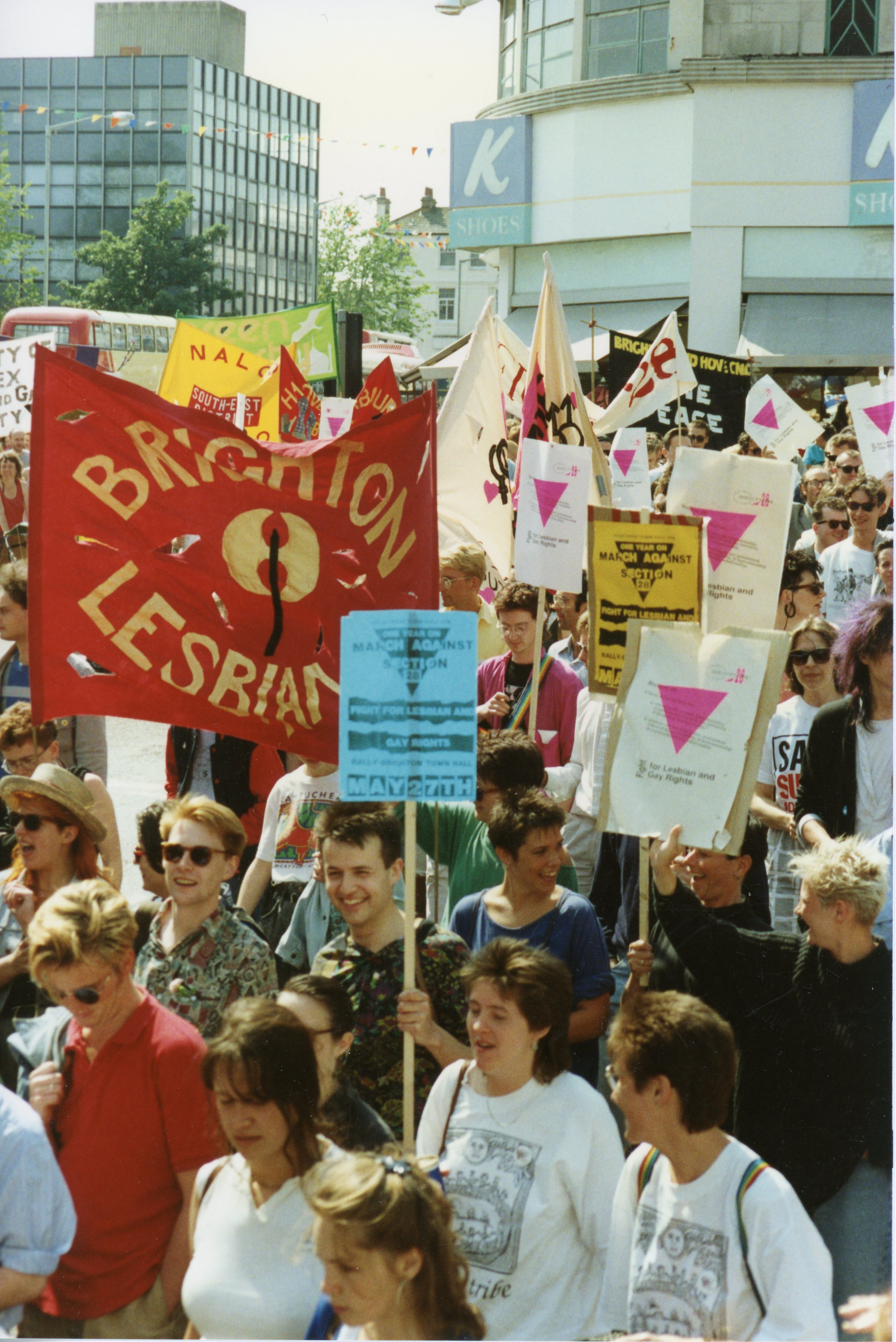
Section 28 Protest March, 1988-89.
The archive can also create a sense of unity and solidarity within the queer community. By engaging with their stories, visitors can feel a connection to the people depicted within the archive. This leads to a stronger sense of community for queer individuals, which is vital. The nature of the archive means that barriers that would have once limited queer solidarity and community are now removed. For example, the archive’s existence online means that anyone can access it regardless of location, time or access requirements. These people are able to explore queer stories and connect with the community in a way that may not have been possible otherwise.
Participants described the significance of seeing evidence of past queer protests:
“Sometimes it feels like, it's kind of an old vs young people thing when you’re protesting, but seeing that like, no, older people have been protesting and it isn’t a new thing or a new idea, I can, I guess, feel more connected to the older generation as well in a way”.
For this participant, the visibility of these protests meant that they were able to feel a stronger connection to different groups of people they may not regularly interact with- for example an older generation. They were able to look outward and situate themselves and their experiences within the broader context of the queer community and feel a sense of solidarity with them.
When asked, as the session was drawing to a close, whether they felt like they had learned something new in the session, one participant answered:
“That we exist, in the first place.”
Looking Forward

Housewife’s Choice photos 26th November 1994.
Lastly, the archive allowed participants to look forward, towards a queerer future. The visibility of such a range of queer stories and experiences meant that their imaginations were expanded, and they started to contemplate the potentials and possibilities of a queer future.
On the representation of lesbian related photographs and event flyers, one participant noted:
“I never see any representation of like, what it would look like to be a lesbian when you’re old, like I feel like…I don't know what my future’s gonna look like being a lesbian, but seeing other people like in black and white that are queer and they look really queer as well, I think that’s really reassuring and that it also feels like you have permission to be able to look like that”.
The Queer Heritage South archive therefore allows participants to look to the future, to imagine a future that they can see themselves in. Although it deals with queer stories and events of the past, the archive is a place completely involved in creating the future. It is not just a static store of information but a living, changing source that reflects the dynamic nature of queerness. Queer Heritage South shows that only by looking to our past, can we look forward to our future.
The research I undertook showed me that digital queer archives such as Queer Heritage South are capable of having an enormous impact on queer lives. Participants found that looking back on queer heritage allowed them to
- Look inward: to reflect on their identity.
- Look outward: to feel a stronger sense of belonging and queer community.
- Look forward: to be inspired to imagine an optimistic, queerer future.
As I continue my internship I hope to explore further the impact of the archive for the community, the ways in which it operates and raises awareness for the importance of visible queer heritage. I am looking forward to assisting with events where I can experience first hand how Queer Heritage South connects with the queer community. During my time I aim to put into practice the skills and experience I have gained from interacting with queer members of the public and researching queer archives.


